Showing posts with label The Arts. Show all posts

Monday, March 21, 2016

Top 10 Amazing Mosaic Artworks

Mosaic is the art of creating patterns and images from small pieces of a certain material, the usual being colored glass or stone. With the advent of technology, the art of mosaic making (which started in Mesopotamia) took a turn for the bizarre. Here are 10 fascinating mosaic artworks made with equally unusual materials.

10
Post-It-Notes
Screen Shot 2010-04-10 At 2.14.04 Pm
The pupils at Eisenhower Junior High School in Taylorsville, Utah, must have been proud of their alma mater, for the school claims to ‘have set more world records than any other school!’ They currently hold nine world records and their record-breaking attempts have appeared in Guiness World Records and Ripley’s Believe It Or Not! One of the records the school broke is the World’s Largest Post-It Mosaic. On November 6, 2009, 151 pupils participated in constructing a 60-feet by 40-feet mosaic using 38,400 colorful Post-It notes. The resulting mosaic illustrated the theme ‘Go Green.’ The Post-It notes were later recycled.

9
Playing Cards
Art.Cards.Eric.Irpt
David Alvarez, an 20-year old art student from Leavenworth, Washington, proved that you didn’t need to be good at drawing to be an artist after unveiling his 25-feet high portrait of Jimi Hendrix made from more than 8,500 Bicycle playing cards (or 168 decks). Using a Photoshop program, he first divided a picture of Jimi Hendrix into parts and map out where the colored playing cards should go. Then, on a single day, Alvarez worked 21 hours painstakingly placing each card on its right position, on a Styrofoam core board, with double-sided tape, only resting for an hour and half before working again. A video documentation of the project, made by Eric Splittgerber, can be seen here.


8
Junk Mail
Sandy Schimmel All American Blonde
Americans get swamped every year by millions of tons of junk mail. Sandy Schimmel, an Arizona artist, decided to put them into good use and creates beautiful, vivid mosaic pictures out of her junk mail in a process known as ‘upcycling.’ Inspired by a mosaic that she saw while in Venice, Schimmel’s artwork are mostly portraits, including a piece featuring Madonna called All American Blonde and a recreation of the famous painting Birth of Venus. To see more of her artwork go here.
7
Gumballs
610X-11
Franz Spohn, illustrator, sculptor and professor of art at Edinboro University in Pennsylvania, specializes in creating large mosaic murals depicting famous people like Barack Obama, Rosa Parks and Robert Ripley from hundreds of gumballs. To achieve this, Spohn fills plastic tubes with several gumballs, stacked according to color, and lines the tubes up to create his masterpieces.
6
Postage Stamps
Stampsnewsteam 450X300
Pete Mason from Staffordshire, England, claims to be the ‘Post Pop Art’ man. Combining Pop Art and graphic design, he creates portraits of famous icons like Martin Luther King, Jr. and Princess Diana out of recycled postage stamps. Typically, his larger works uses around 20,000 stamps. To make a portrait, Mason first draws the picture he will work on on a canvas. Then, he divides the picture in stamp-size squares. Then, the stamps, sorted out by color, design and postmark pattern, are applied to the surface.


5
Computer Parts
Mona Lisa Technology Smiling
In an art exhibition in Beijing, China, in 2006, a group of computer engineers displayed a recreation of da Vinci’s Mona Lisa made out of computer parts. Made of various circuits and chip sockets, the work, entitled Technology Smiling, fascinated the visitors.
4
Apples
Emmakl
Since 1988, Emma Karp and her father Helge Lundstrom have been creating huge apple mosaics for the annual Kivik Apple Festival. The Swedish town has long been an important fruit supplier in Sweden, and the festival celebrates the end of the harvesting season in Sweden, which is around late September. The centerpiece of the festival is the apple mosaic, which can contain up to 75,000 apples in different varieties, which is equivalent to 8,820 pounds.
3
Fruit and Veggie Sticker Labels
Screen Shot 2010-04-10 At 2.20.34 Pm
Barry Snyder of Erie, Colorado, creates amazing mosaic artworks out of those annoying stickers you see in store-brought fruit and vegetables. His 4-sq-ft creations are typically made out of around 4,000 stickers and take him around six months to create. Many of the stickers he uses are sent to him by people from around the globe. His original works are so popular that they can sell for up to $10,000. If you want to donate stickers, or to view Snyder’s works, go here.
2
Bar Codes
Screen Shot 2010-04-10 At 2.22.47 Pm
Scott Blake specializes in creating portraits of famous icons out of bar codes. His bar code art was inspired by the Y2K computer bug, where he created his first bar code mosaic of Jesus Christ using Photoshop. Since then, he has created around thirty portraits of famous icons such as Andy Warhol and Arnold Schwarzenegger. Scoot also created several interactive pieces where scanning the bar codes on the mosaic flashes up images of the person pictured in the mosaic on a screen . This was done on Scott’s portrait of Bruce Lee and Elvis Presley. For more information, visit here.
1
Burnt Toast
Mona Lisa04
Maurice Bennett of New Zealand, tops the list for his mosaic portraits of famous people made from thousands of toasted bread, burned in varying degrees to create different shades. His works have depicted such greats as Jonah Lomu, John Key (NZ Prime Minister) and Peter Jackson. His works are typically displayed on billboards, where his works are best viewed. To learn more about Bennett, go here.
Bonus
Children’s Hands
Marcus-Harvey-Myra
This is a bonus item as it is not strictly a mosaic in the sense that it is made with various objects – but it is close – for reasons that will become apparent: Marcus Harvey is best known for his tabloid-provoking 9 by 11 feet (2.7 by 3.4 m) portrayal of Moors murderer Myra Hindley, created from the handprints of children, and shown in the Sensation exhibition at the Royal Academy of Art in 1997. The painting had to be temporarily removed from display for repair after it was attacked in two separate incidents on the opening day, in which ink and eggs were thrown at it. One art critic said of the work: “[f]ar from cynically exploiting her notoriety, Harvey’s grave and monumental canvas succeeds in conveying the enormity of the crime she committed. Seen from afar, through several doorways, Hindley’s face looms at us like an apparition. By the time we get close enough to realize that it is spattered with children’s handprints, the sense of menace becomes overwhelming.”

Source here

Top 15 Shipwreck Survival Tips

This is a list of the most important things to remember if you are shipwrecked. The list comes from Yan Martel’s prize-winning novel, Life of Pi.
1. Always read instructions carefully
2. Do not drink urine. Or sea water. Or bird blood
3. Do not eat jellyfish. Or fish that have spikes. Or fish that have parrot like beaks. Or that puff up like balloons.
4. Pressing the eyes of fish will paralyse them
Read the bestselling book Life of Pi at Amazon.com!


5. The body can be heroic in battle; if a castaway is injured, beware of well-meaning, but ill-founded, medical treatment. Ignorance is the worst doctor, while rest and sleep are the best nurses.
6. Put your feet up at least 5 minutes every hour
7. Unnecessary exertion should be avoided. But an idle mind tends to sing, so the mind should be kept occupied with whatever light distraction may suggest itself. Playing card games, twenty questions and I spy are excellent distractions.

8. Green water is shallower than blue water
9. Beware of far-off clouds that look like mountains. Look for green. Ultimately, a foot is the only good judge of land.
10. Do not go swimming. It wastes energy. Besides, a survival craft may drift faster than you can swim. Not to mention the danger of sea life. If you are hot, wet your clothes instead.
11. Do not urinate in your clothes. The momentary warmth is not worth the nappy rash.
12. Shelter yourself. Exposure can kill faster than thirst or hunger.
13. As long as no excessive water is lost through perspiration, the body can survive up to 14 days without water. If you are thirsty, suck a button.
14. Turtles are an easy catch and make for excellent meals. Their blood is a good, nutritious, salt-free drink; their flesh is tasty and filling; their fat has many uses; and the castaway will find turtle eggs a real treat. Mind the beak and the claws.
15. Don’t let your morale flag. Be daunted but not defeated. Remember: the spirit, above all else, counts. If you have the will to live, you will. Good luck!

Monday, February 15, 2016

10 More Artistic Uses of Ordinary Things

This is a sequel to Top 10 Amazing Mosaic Artworks, which I highly suggest you visit to get the gist of the list. I love modern art, and the lengths to which people will go to express themselves through it. Mosaic art is a particular favorite of mine, and it just fascinates me how people today can do so much with this ancient art form. Here are ten more unusual and fascinating mosaic artworks that will definitely catch your attention.

10
Toothpicks
Saimir-Strati-Toothpick-Horse-Mosaic
Saimir Strati, an Albanian artist, holds the Guiness World Record for creating the largest toothpick mosaic. The 86.11-square feet creation is made of 1.5 million toothpicks, and took 40 days to complete. The mosaic, which depicted a galloping horse, was displayed at the Arbnori International Centre of Culture, Tirana, Albania on 4 September 2007.

9
Corks
Saimir Strati The Guitarist Mosaic Corks02
Saimir Strati gets another spot on my list for his other record-breaking piece, a 988-square feet mosaic made of 229,675 bottle corks. Depicting the theme ‘Mediterranean’, the giant mosaic was unveiled on Sept. 4, 2008 along with 9 other mosaics, including two other record-breaking mosaics made out of nails and toothpicks (see previous entry). Surprisingly, the giant installation, which was displayed in the gardens of the Sheraton Tirana Hotel and Towers, took only 27 days to complete.


8
Pencils
Pencil-Vania Ajr-04 Med
Jaina Davis of San Francisco, California, owns a house with a difference. The house, whose interior was decorated by various artist friends of Davis, boasts an amazing staircase completely covered in pencils. The staircase, entitled ‘Pencil-vania,’ was made by Jason Mecier, and features a flower garden mosaic and a futuristic portrait of Jaina Davis, aged 88, all made from pencils. The installation, which took five years to build, contains 92,626 pencils, plus various erasers, sharpeners and other school supplies.
7
Buttons
B0215 Ran-Hwang-003
Artist Ran Hwang specializes in creating stunningly beautiful images out of buttons. The buttons are pinned on the surface to create pictures such as birds, trees and Buddha figures. To see more of her whimsical art, go here.
6
Postcards
Mach Teaser
Scottish artist David Mach creates amazing artworks out of thousands of postcards. One particularly amazing work is his depiction of a racehorse made from 8,000 identical postcards of the Jumeirah Emirates Towers in Dubai, which measures 12 by 9 feet. To see more of Mach’s works, go here.


5
Larkspur
Flower Flag 2 2002
In celebration of Flag Day in June 14, 2002, the city of Lompoc, California, created a 740 x 390 foot US flag made out of 400,000 larkspur flowers. The flag covered 6.65 acres and the stars measured 24 feet in diameter.
4
Gatorade Bottles
Gatorade-Michael-Jordan-St-Alfred-Commercial-1
To celebrate his induction into the Naismith Memorial Basketball Hall of Fame, Gatorade teamed up with an American advertising agency to create an amazing mosaic of ‘His Airness’ Michael Jordan from 14,641 Gatorade bottles. The mosaic, illuminated by 200 light boxes, took 16 hours to complete and used limited edition Jordan Gatorade bottles in various flavors.
3
Sushi

On March 17, 2008, students of the Institute of Hotel Management, Catering Technology and Applied Nutrition in Mumbai, India succeeded in breaking a very unusual record. 20 students gathered to create a 15.16-square meter mosaic made out of 5,814 sushi pieces, breaking the previous record set by the Association of Chartered Certified Accountants (ACCA) in Poland, which measured 14.84 square meters. Maki Sushi, Inari Sushi, Nigiri Sushi, Uramaki Sushi, and Chirashi Sushi comprised the mosaic.
2
Origami
Largest Origami Mosaic World Record
On July 26, 2008 Hong Kong Youth Visual Art Association, Hong Kong Chinese Arts Festival, Lo Fung Art Gallery Ltd and Hong Kong Union of Visual Artists Limited, along with 2,000 participants, teamed together to create the largest origami mosaic in the world. The event took nine hours, and entails the creation and pasting of over 100,000 colorful origami stars. The finished mosaic measured 3,453 square feet, depicted five pandas joining hand in hand, symbolizing the Chinese people’s welcome to the coming of the 2008 Olympics in Beijing, China.
1
Cups of Coffee
Mona-Lisa-Coffee 1444352I
In late 2009, a mosaic reproduction of the famous painting Mona Lisa made from 3,604 cups of coffee was created for the Rocks Aroma Festival in Sydney, Australia. Measuring 20 x 13 feet, it was created by the Sydney Harbour Foreshore Authority. A team of eight people took three hours to arrange the cups of black coffee, which are ‘shaded’ into different sepia tones by 564 pints of milk.

Source here

Tuesday, January 5, 2016

Another 10 Artistic Uses of Ordinary Things

Artists see the world differently than other people. It is this special view of the world that makes them outstanding in their various fields. This list shows another ten artists who used their special perspectives to create unique works of art from otherwise mundane objects. If you have other suggestions for other artists that I should add to this list, feel free to add them in the comments.

10
Watermelons
Img201
Takashi Itoh is a Japanese food sculptor who specializes in carving amazing designs on watermelons. The idea came to him after he saw a watermelon sculpture at a Thai culture festival. Duly inspired, he started teaching himself how to carve the fruit, and three weeks later, he mastered the craft. His carvings, which can take up to ninety minutes to complete, include dragons, slogans, cranes, tortoises and a series of athletic designs inspired by the 2008 Beijing Olympics. He even made a self-portrait of himself on the fruit. For more of Itoh’s delicious art, go to his website.

9
Matchsticks
Screen Shot 2010-06-14 At 2.45.16 Pm
Scottish artist David Mach is a highly innovative artist who has created many extraordinary artworks from ordinary materials, such as postcards, bricks and coat hangers. His recent works include a series of 3D portraits of famous icons like Marilyn Monroe and Elvis Presley, made from thousands of colored matchsticks. The sculptures were made by painstakingly gluing matches, with the tip facing outward to a fiberglass mold. Thus, the sculptures can take 500 hours to complete, although occasionally after finishing a sculpture, Mach torches his work and lets it burst into flames, as a fitting finale to his flammable art. For more of his fascinating works, go to his site.


8
Phonebooks
Einstein
Alex Queral, from Philadelphia, is a sculptor with a difference. He creates portraits of famous people from discarded phonebooks. He does this by first making a freehand sketch of the person he will carve. Using the sketch as a template, he then places it over the phonebook and starts carving the face into the pages using an artist’s scalpel or razor blades. ‘It can be quite tense work sometimes because it takes a long time to finish and when you cut something away you can’t get it back again. Nearing the end of the carving and then suddenly having it ruined by a careless cut can be pretty crushing. You have to start all over again,’ said Queral. He now makes up to two new carvings each month and has produced carvings of Barack Obama, Jack Nicholson and the Dalai Lama on the discarded books. For more photos, go here.
7
Corrugated Cardboard
Unclesama
Mark Langan, a self-taught artist, has perfected the art of using corrugated cardboard to create intricate sculptural pictures. Each of Langan’s pieces was visualized using no computer rendering; a simple sketch is used. Each artwork entails cutting, layering and sealing the individual pieces using nontoxic glue. Not only is the finished work beautiful, but it is totally environmentally-friendly. To see more of his artwork, go to his site.
6
Hard Drives
Recycled-Hard-Drive-Sculptures 4
Miguel Rivers, a systems administrator, creates beautifully complex metal sculptures from used computer hard drives. Rivera’s first project was a car out of 33 standard 3.5-inch hard drives, which took an entire weekend to make. Now, he has created other cars, motorcycles and robot-like figures out of the metallic medium. For more photos, go here.


5
Dollars
Screen Shot 2010-06-14 At 2.47.45 Pm
At the O.H.W.O.W. gallery in Miami, Florida, Scott Campbell, a Louisiana tattoo artist, showed his works, with the highlight of the exhibit being a series of laser-cut carvings made on several stacks of dollar bills. The unique collection contains designs that showcase Campbell’s distinct tattooing style, including a thorned rose, the Virgin Mary, and a handgun. For more pictures as well as a sampling of Campbell’s tattoo art, visit his website.
4
Tortillas
Luchador2
Los Angeles artist Joe Bravo is a painter. Nothing unusual about that, except that his choice of canvas is not paper, but flour tortillas. He first dries the tortillas naturally or by using an oven, then varnishes both sides so that it could be painted on with acrylic. After finishing a work, he protects the image from moisture by coating it with more varnish. His paintings are often inspired by the texture and burn marks present on the tortillas themselves. Bravo has created tasty images of famous icons such as Marilyn Monroe, Che Guevara, Ronald McDonald and La Virgin de Guadalupe. He has earned such a reputation from his tortilla art that he has sold some of his works for more than $3,000. For more of his yummy art, visit his site.
3
Crayons
Main
Herb Williams, from Tennesee, creates whimsical sculptures and installations out of that kindergarten classroom staple, crayons. He uses up to 250,000 crayons for his artworks. Because of this, his studio is filled from top to bottom with boxes of 3,000 single-color crayons, and he is one of the only individuals in the world with an account with Crayola, where he gets most of his materials. For more of his colorful art, go here.
2
Old reference books
Picture2
Brian Dettmer, from Atlanta, Georgia, resurrects old reference books into beautifully intricate masterpieces. In a process that he calls a ‘book autopsy’, Dettmer seals the edges of the books he uses before performing ‘surgery’ on their pages. Using surgical tools like scalpels and tweezers, he dissects sections of the book’s text, leaving interesting text and illustrations intact. Nothing is added or altered, only removed, so everything that’s left is in its’ original place in the book. Titles that were ‘operated’ on by Dettmer includes ‘Household Physician’ and ‘Webster’s New International Dictionary’. For more photos, go here.
1
Light

Lichtfaktor is the name of a group of graffiti artists based in Cologne, Germany. Only these graffiti artists don’t work with spray paints: they use flashlights, neon tubes, glowsticks, LEDs and other mobile sources of light to create dazzling shapes and brilliant swirls, that illuminate dreary cities with their momentary glow. Then, using a special camera with a long exposure, the group captures these light ‘sketches’ to preserve them for future appreciation. The group, comprising of graffiti artists Tim Feshke and David Lupschen, and video engineer Marcel Panne, also make videos of their art, using stop-motion animation to make their light graffiti come alive. In one particular video, entitled ‘Star Wars vs. Star Trek’, Tim and David made trash cans come alive, staged a fantastic light saber fight, and ‘teleported’ themselves through the gloomy streets of Germany. For more of their bright art, go here.

Source here

Wednesday, October 28, 2015

10 Fascinating Models in Famous Art

I should start out by saying that I have never studied art and know very little about it. I don’t know what makes a good painting great, or a great painting a masterpiece, but I do know what makes one famous. That would be any painting that even a guy like me would recognize. This list is not about colors, depth of field, symbolism, interpretation or why the artist chose to paint on beaverboard over canvas. This list looks at the personal lives of the people that have posed as subjects or models in 10 well known paintings – a subject that I feel is never discussed enough. Please comment if anyone feels the information I have gathered is not entirely accurate, or if you have any other interesting facts on these subjects and models.

10
American Gothic
American Gothic
Artist: Grant Wood 1891 –1942
Year Painted: 1930
Grant Wood painted American Gothic as the United States was entering the Great Depression. Wood was looking for models that would capture the essence of hard-working Middle America. The artist decided on using the family dentist, Dr. B.H. McKeeby (1867–1950), to model for the older man and his sister, Nan Wood (1899–1990), for the younger woman. The two, reluctantly, posed for the painting after Wood assured them that they would not be recognized. The models never stood in front of the house, and sat separately for the painting. The painting became one of the most famous images in the world, and one of the most parodied. Nan married a real estate investor and spent the rest of her life as a historian for her brother’s work. Dr. McKeeby kept the practice that he established in 1901 in Cedar Rapids, Iowa, almost until his death. You can see Dr. McKeeby and Nan Wood standing next to the famous painting here.
Interesting Fact: There is something of a debate as to whether the painting is meant to depict a husband and wife. Many experts believe that Wood painted them as a couple, originally. It is also said that Nan Wood was embarrassed at being depicted as the wife of someone twice her age, and began telling people that the painting was of a man and his daughter. In a letter written by Grant Wood in 1941, he seems to confirm that the woman is the man’s “grown up daughter”. You can read the actual letter here.

9
Pinkie
Thomas Lawrence Pinkie1
Artist: Thomas Lawrence 1769 –1830
Year Painted: 1794
Pinkie is the portrait of Sarah Barrett Moulton, who was approximately eleven years old when she was painted. Sarah was the daughter of a wealthy Jamaican plantation owner named Charles Barrett Moulton. She was born and raised in Jamaica, and traveled to England to further her education. While in England her grandmother commissioned Thomas Lawrence to paint the, now famous, portrait. Sadly, Sarah died on April 23, 1795, just one year after the portrait was completed, due to whooping cough, which she most likely contracted from one of her brothers. Her brother Edward, who would later own the portrait, changed his surname to Moulton-Barrett and became the father of one of the most prominent poets of the Victorian era, Elizabeth Barrett Browning, making Sarah Elizabeth’s aunt.
Interesting Fact: Prints of Pinkie and The Blue Boy are often sold or displayed together, as if they are related in some way, or painted by the same artist. They are actually works by different artists, and painted a quarter century apart. Both works are now the property of The Huntington at San Marino, California, where they hang across from one another in the same room.


8
Whistler’s Mother
Whistlers-Mother
Artist: James McNeill Whistler 1834 –1903
Year Painted: 1871
Most would consider Whistler’s Mother a strictly all American iconic symbol. However, many are not aware that she was actually painted, and died, outside the US. Anna McNeill Whistler was born in 1884 in North Carolina. In 1831, she married widower George Washington Whistler, and inherited 3 stepchildren. Anna gave birth to two sons, James and William. She also had two other sons who died at a young age. In 1842 the family moved to Russia when her husband was hired as a railway engineer. After her husband died from cholera in 1849, she returned to the US to live in Connecticut. During the Civil War, Anna crossed lines to be with William, who was a surgeon in the Confederate Army. She then went to London where James moved after getting kicked out of West Point. Anna encouraged his painting and agreed to pose for her son. James then painted the now famous ‘Arrangement in Grey and Black No.1 Portrait of the Artist’s Mother” commonly referred to as “Whistler’s Mother.” Anna died in Hastings, England, in 1881. James arranged for her burial in the Borough Cemetery, and on her white gravestone is inscribed: “Blessed are they who have/not seen/And yet have believed.”
Interesting Fact: Anna’s husband, George (”Whistler’s Father”), was actually a very prominent railroad engineer. Stone arch railroad bridges that he built in 1841 are still in freight and passenger service in western Massachusetts. He also invented a system of communication between the locomotive engineer and the train crew, known as ‘Whistler’s Trumpet’. While in Russia, he served as consultant on the building of Russia’s first major railroad, the Moscow-Saint Petersburg Railway. He is also credited with selecting the five-foot rail gauge that is still used in Russia and neighboring countries. For his efforts he was awarded the Order of St. Anna from Tsar Nicholas.
7
Christina’s World
Wyethachristina'sworld
Artist: Andrew Wyeth (1917– 2009)
Year Painted: 1948
Andrew Wyeth was inspired to create this painting at his summer home in Cushing, Maine, when he was looking through his window and saw a woman crawling across a field. The woman’s name is Christina Olson (1893-1969). Christina had a degenerative muscular disorder (sometimes identified as polio) that took away her ability to walk. Wyeth met Olson and her brother, Alvaro, in 1939 when they were introduced by a woman named Betsy. Betsy would later become the artist’s wife, and also a summer resident in Cushing. There are two models who posed for the woman in this painting. The figure’s thin legs, arms and pink dress belong to Christina Olson, who was in her mid 50’s at the time. The head and torso belong to Wyeth’s wife Betsy, who was in her mid 20’s at the time. Christina Olson lived in her house her entire life, and neighbors say she had no idea that she, or her house, had become famous. In the year 2000, Andrew and Betsy Wyeth celebrated their 60th wedding anniversary.
Interesting Fact: A friendship developed between the artist and the Olsons, and Wyeth was even allowed to use an upstairs room as a studio. The Olson House was placed on the National Register of Historic Places in 1995. You can see a photo of the Olson’s House as it appears today here.
6
Le déjeuner sur l’herbe
Dejeuner Sur L’herbe, By Edouard Manet
Artist: Édouard Manet 1832-1883
Year Painted: 1862/63
Manet created quite a stir with the French public when this painting went on display in 1863. There are actually two people who modeled for the nude woman. Manet used his favorite model, Victorine Meurent (1844- 1927), for the woman’s face and his future wife, Suzanne Leenhoff (1830-1906), for the woman’s body. Suzanne Leenhoff had a ten year relationship with Manet before they finally married in 1863. The two met when Suzanne, who was a musician, was hired by Manet’s father to give Edouard and his brother, Eugene, piano lessons. During their ten year relationship, Suzanne gave birth to a son, Leon Koella. Both Manet and his father have been proposed as the boy’s natural father. Leon was introduced to other people as Suzanne’s younger brother. The face model, Meurent, was also an artist and had many exhibits at the prestigious Paris Salon. The two men in the painting are Manet’s brother, Eugene and his future brother in law, Ferdinand Leenhoff.
Interesting Fact: A painting by Victorine Meurent, called Le Jour des Rameaux or Palm Sunday, was recovered in 2004, and is the only surviving example of her art work. You can see the painting here.


5
The Weeping Woman
173
Artist: Pablo Picasso 1881 –1973
Year Painted: 1937
If you are familiar with Picasso’s work you will know the model used for this painting is Dora Maar (1909-1997). Maar was a French photographer, poet and painter. She was also Picasso’s mistress, from 1936 until 1944. They were introduced when she was 29 and Picasso 54. In the course of their relationship, Picasso said this about Maar, “For me she’s the weeping woman. For years I’ve painted her in tortured forms, not through sadism, and not with pleasure, either; just obeying a vision that forced itself on me. It was the deep reality, not the superficial one.” “Dora, for me, was always a weeping woman….And it’s important, because women are suffering machines”. Maar was an independent artist, but she eventually came to suffer from their relationship after after discovering she was unable to have children. Picasso also referred to Dora as his “private muse”. She spent her last years living, alone, in a house near Paris that Picasso had given her.
Interesting Fact: In 2006, another one of Picasso’s portraits of her (“Dora Maar with Cat”) was auctioned at a closing price of $95,216,000, making it the world’s second most expensive painting ever sold at auction. You can see most of Picasso’s paintings and sketches of Dora Marr here.
4
Portrait of Adele Bloch-Bauer I
Portrait Of Adele Bloch Bauer 01
Artist: Gustav Klimt 1862 –1918
Year Painted: 1907
Adele Bloch-Bauer was born in Vienna, Austria, in 1881, into a wealthy Jewish banking family. In 1899, at age 17, she married sugar magnate and banker Ferdinand Bloch Bauer. Ferdinand was a major patron of Gustav Klimt, and commissioned him to paint a portrait of Adele. In 1907, three years and hundreds of sketches later, Adele’s portrait was completed. Klimt would go on to paint Portrait of Adele Bloch-Bauer II, in 1912. Adele was the only model to have been painted by Klimt more than once. The Bloch-Bauers were well-established in Klimt’s inner circle, which also included Sigmund Freud and composer Arnold Schoenberg. Scholarly opinions differ as to whether or not Klimt and Adel were having an affair. The Bloch-Bauers purchased 6 of Klimt’s works, including both portraits of Adele and four of Klimt’s mood landscapes. On January 24, 1925, Adele died suddenly of meningitis, in Vienna. In her will, she asked her husband to donate Klimt’s paintings to the Austrian Gallery after his death. In 1938, when the Nazis invaded Austria, Adele’s widowed husband had to flee abroad because of his Jewish roots, and was forced to abandon all his possessions. His property was confiscated, including the Klimt paintings.
Interesting Fact: In a 1945 testament by Ferdinand Bloch-Bauer, he designated his nephew and nieces, as the inheritors of his estate. After a lengthy court battle between the United States and Austria, it was finally established in 2006 that Maria Altmann (Bloch –Bauer’s niece living in California) was the rightful owner of the paintings. Later that year, the Portrait of Adele Bloch-Bauer I was sold for a reported $135 million, making it one of the most expensive works of art ever to change hands.
3
Luncheon of the Boating Party
The20Luncheon20Of20The20Boating20Party20Ii
Artist: Pierre-Auguste Renoir 1841-1919
Year Painted: 1881/82
Renoir often included several of his friends in his works, and this one is no exception. Included among many of his friends in this painting, is his future wife Aline Charigot (the one cooing with the dog). Another friend in the painting is the famous French painter Gustave Caillebotte, who is seated in the lower right. Renoir and Aline were married in 1890, five years after the birth of their first son, Pierre. Aline became the love of Renoir’s life, and she is immortalized in many of his other paintings. They later had two more children, Jean and Claude. Although Aline was 23 years younger than her husband, she died four years before Renoir, in 1915. You can see a photograph of the couple later in life here.
Interesting Fact: Two of their sons, Pierre and Jean, became well known actors and film directors. Jean was nominated for an Academy Award for directing the film The Southerner. In 1975 he received a lifetime Academy Award for his contribution to the motion picture industry.
2
Portrait of Dr. Gachet
Portrait Of Dr Gachet
Artist: Vincent van Gogh 1853 –1890
Year Painted: 1890
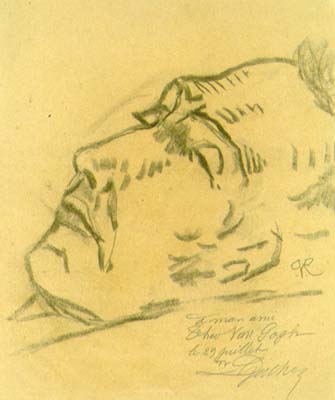
Dr. Paul Gachet (1828-1909) was a great supporter of artists and the impressionist movement, in part because he, himself, was an amateur painter. The doctor was also friends with, and treated, famous artists such as Pissarro, Renoir, Manet and Cezanne, and amassed one of the largest impressionist art collections in Europe. Dr. Gachet married Blanche Castets in 1868, and had two children, Marguerite and Paul. In May of 1890, after van Gogh was released from an asylum for mental illness, he remained in need of medical supervision. Van Gogh’s brother, Theo, thought that Dr. Gachet was a good choice to treat van Gogh, because of his love for art. During the time van Gogh spent with him, he said this about the physician “sicker than I am, I think, or shall I say as much”. No one really knows what the artist meant by these words, but some believe van Gogh knew the Doctor was not fit to treat him. On July 27, 1890, van Gogh went into a field to paint and shot himself in the chest with a revolver. Dr. Gachet was summoned but his wound was inoperable and van Gogh died two days later. It should be noted that none of van Gogh’s family held Gachet responsible for his patients death.
Interesting Fact: Dr. Gachet practiced his art under the name Paul van Ryssel. His most famous work is a sketch of Van Gogh on his death bed and can be seen here. The doctors son, Paul Louis, became an art dealer after inheriting hundreds of works of art from his father. Like his father, he was also an amateur artist, and painted under the name Louis van Ryssel. He kept the family tradition going by also sketching Van Gogh on his death bed. You can see a see his sketch here.
1
Mona Lisa
Mona-Lisa
Artist: Leonardo da Vinci 1452 – 1519
Year Painted: c-1503-1506
I know this is an obvious choice for number 1, but how could she not be? Even though Mona Lisa’s real name and identity was first linked around 1550, it wasn’t until just a couple of years ago that it was 100% confirmed. Her real name is Lisa del Giocondoa, member of the Gherardini family. She was born in Florence on the 15th of June, 1479, and was the oldest of seven children. At age 15 she married Francesco del Giocondo, a cloth and silk merchant. After some business success in 1503, her husband was able to buy a house next door to his family’s old home, in the Via della Stufa. It is believed that it was then that her portrait was commissioned by her husband, perhaps to celebrate their new house, or maybe to mark Lisa’s 2nd pregnancy. During the painting of Lisa, Da Vinci’s handwritten notes make reference to Lisa’s cheerful personality and her engaging laughter. Lisa and Francesco had five children: Piero, Camilla, Andrea, Giocondo and Marietta. Lisa also raised Bartolomeo, the son of Francesco and his first wife, who died just a year after he was born. Daughters Camilla and Marietta became Catholic nuns. Camilla took the name Suor Beatrice and died at age 18, while Marietta took the name Suor Ludovica, and became a respected member of the convent. Accounts of Lisa and Francesco’s days together differ, but there is no dispute over Francesco’s undying love for his wife, Lisa. Francesco died at the age of 80, around 1538, when the plague swept the city. Some historians claim Lisa died four years later, but same say she lived into her seventies, dying around 1551.
Interesting Fact: In 1506 Leonardo considered the portrait unfinished. He was never paid for the work, and did not deliver it to his client. The painting traveled with him throughout his life, and he most likely completed it many years later in France.

Surce here

Thursday, September 3, 2015

10 Rhetorical Figures

Rhetoric is the art of persuasion through written, oral, or visual means. The idea of rhetoric has been around since the classical days. One of the greatest works on this subject which still exists from the classical period is The Orators Education, by Quintilian (if you are feeling particularly generous, I give you permission to buy me a copy from my amazon wishlist – it is on page 1 and there are 5 books.) Some of the greatest speakers and speeches from history were written by people with a great knowledge of rhetoric – for example John F Kennedy, Winston Churchill. Some of the famous tropes you have probably heard of are Irony, onomatopoeia, alliteration, and assonance. I like to think of it like this: grammar is the science of good writing; rehetoric the art. That was zeugma (item 6) by the way. This is a list of ten rhetorical tropes (figures of speech) to get you started on the road to mastery of the art.
Rhetoric-1
10. PolysyndetonEmploying many conjunctions between clauses, often slowing the tempo or rhythm.
I said, “Who killed him?” and he said, “I don’t know who killed him but he’s dead all right,” and it was dark and there was water standing in the street and no lights and windows broke and boats all up in the town and trees blown down and everything all blown and I got a skiff and went out and found my boat where I had her inside Mango Key and she was all right only she was full of water. —Ernest Hemingway, “After the Storm.”
Learn the art of persuasion with Thank You For Arguing at Amazon.com!

9. Asyndeton
The opposite of polysyndeton – the omission of conjunctions between clauses – employed in a very famous quote:
Veni, vidi, vici (Caesar: “I came; I saw; I conquered”) – omitting “and” and “then”
Brachylogia is similar to this though it omits conjunctions between single words to give a hurried feel: “John! Rise, eat, leave!”


8. Hysyteron ProtoronI love this one because you can have a lot of fun with it. This is the reversal of words based upon the order of time. This is something we all use often – the best example being: “Put on your shoes and socks” – obviously you must put your socks on first. This is a type of hyperbaton which is simply a reversal of word order without relation to time: “Why should their liberty than ours be more?” Shakespeare.
Th’ Antoniad, the Egyptian admiral,
With all their sixty, fly and turn the rudder. —Shakespeare, Antony and Cleopatra 3.10.2
Rhetoric Cesari
7. Homoioteleuton
Similarity of endings of adjacent or parallel words.
He is esteemed eloquent which can invent wittily, remember perfectly, dispose orderly, figure diversly [sic], pronounce aptly, confirme strongly, and conclude directly. —Peacham
6. Zeugma
A general term describing when one part of speech (most often the main verb, but sometimes a noun) governs two or more other parts of a sentence (often in a series).
As Virgil guided Dante through Inferno, the Sibyl Aeneas Avernus. —Roger D. Scott
Grammar is the science of good writing; rehetoric the art. —jfrater
Click here to access 40,000 movies and TV shows with Amazon Prime Instant Video – 30 day free trial at Amazon.com!


5. MetonymyReference to something or someone by naming one of its attributes. For example, “He bought a great set of wheels” – wheels being the attribute of the actual object he bought: a car. Another example: “We await word from the crown.” The crown is an attribute of the King, and in this context is a reference to the King himself, not the crown he wears.
4. Litotes
Deliberate understatement, especially when expressing a thought by denying its opposite. This is a form of modesty often used to gain favor with one’s audience:
It isn’t very serious. I have this tiny little tumor on the brain. —J.D. Salinger, The Catcher in the Rye
3. Anaphora
Repetition of the same word or group of words at the beginning of successive clauses, sentences, or lines. I am certain you will have heard the greatest modern example of this one:
We shall go on to the end, we shall fight in France,
we shall fight on the seas and oceans,
we shall fight with growing confidence and growing strength in the air, we shall defend our Island, whatever the cost may be,
we shall fight on the beaches,
we shall fight on the landing grounds,
we shall fight in the fields and in the streets,
we shall fight in the hills;
we shall never surrender[…] Sir Winston Churchill
Sir Winston was famed for his great speeches – but what few know is that he would pore over them making great use of rhetoric, and then memorize them. He managed to perform his speeches as if he were speaking from the top of his head. He is recognized as one of the greatest statesmen – and rhetoric is one of the reasons why.
Plato-Raphael
2. Diaskeue
Something the press should use less often! This is the graphic peristasis (description of circumstances) intended to arouse the emotions.
Look at my children, their emaciated cheeks, their bare feet, their hunger to know something more than hunger…
1. Paralipsis
This is a wonderful rhetorical trope – it is stating and drawing attention to something in the very act of pretending to pass it over. A kind of irony.
“It would be unseemly for me to dwell on Senator Kennedy’s drinking problem, and too many have already sensationalized his womanizing…”
I now challenge you to use at least one of these tropes in the comments below (in your own words, not quoted from a famous speech).

Source here

Tuesday, August 18, 2015

Top 10 Art Thefts of the 20th Century

The theft of treasure is nothing new – it is one of folklore’s most persistent themes – but thanks to novels, films and the newspaper headlines, art theft has captured the public’s imagination like few other types of crime have. Below is a list of the top 10 (plus a bonus) post-war art thefts.
1. The Duke of Wellington – Goya
Heist Goya 209X250
In 1961, Charles Wrightsman, the oil-rich American collector, bought Goya’s “Portrait of the Duke of Wellington” for $392,000 and planned to take it to the United States. There was such a public outrage that the British government raised the necessary matching sum. Less than three weeks after its triumphal hanging in the National Gallery, it was stolen. The thief demanded a ransom of the same amount and said he was going to devote it to charity.
In 1965, the thief sent a claim ticket to London’s Daily Mirror and the painting was picked up by police in a railway baggage office. The thief, an unemployed bus driver named Kempton Bunton, gave himself up six weeks later. He had planned to use the money to buy TV licenses for the poor, serving three months in jail for his offense.
Read about the men who defied Hitler and went on a daring mission to recover stolen artwork from the Nazis! Get The Monuments Men: Allied Heroes, Nazi Thieves and the Greatest Treasure Hunt in History at Amazon.com!

2. The Flagellation of Christ – Piero della Francesco
Heist Francesca 377X264
Italy, the home of art, has also been the home of art theft. When two paintings by Piero della Francesco, “The Flagellation of Christ” and “The Madonna of Senigallia” and a Raphael, “The Mute,” were cut from their frames and stolen from the Ducal Palace, Urbino, it was described as “the art crime of the century.”
The crime was wholly driven by profit. It was committed by local criminals who planned to sell the work on the international market and would not be the last to discover that much-reproduced masterworks are hopelessly illiquid. The paintings were recovered undamaged in Locarno, Switzerland, in March 1976.
3. Various Paintings – Renoir, Monet, Corot
Heist Monet 377X316
The theft of nine paintings, including Renoir’s “Bathers” and Monet’s “Impression, Soleil Levant,” which gave Impressionism its name, from the Marmottan Museum, Paris, took place in 1985. The police at first theorized that the radical group Action Direct had committed the crime. But several paintings stolen from a provincial French museum in early 1984 were recovered in Japan after a tip-off from a fence. The paintings–including Corots–were in the hands of Shuinichi Fujikuma, a known gangster. He had been behind the Marmottan heist too. Indeed, he had circulated a catalogue of the nine soon-to-be-stolen paintings.
Japan’s short statute of limitations on stolen art was notorious, and rumors became rampant that the Japanese mob, aka the Yakuza, had penetrated the art world. The truth was on a smaller scale. Fujikuma had been arrested in France with 7.8 kilos of heroin in 1978. During a 5-year sentence, he came to know Philippe Jamin and Youssef Khimoun, members of an art theft syndicate. They pulled the job for him. But the paintings were recovered in 1991–in Corsica.
4. Pacal’s Burial Mask – Historical
Heist Pacal 235X365
In December 1985, guards from the National Museum of Anthropolgy in Mexico arrived at work to discover that sheets of glass had been removed from seven showcases. The 140 objects that were taken included jade and gold pieces from the Maya, Aztec, Zapotec and Miztec sculptures. The curator, Felipe Solis, estimated that one piece alone–a vase shaped like a monkey–could be worth over $20 million on the market–if a buyer could be found.
Most of the pieces were an inch or so in height. The entire haul would have fitted comfortably into a couple of suitcases. It is still accounted as the single largest theft of precious objects. The Burial Mask was recovered.
5. Rayfish with Basket of Onions – Chardin
Heist Chardin 377X477
The break-in at the Manhattan branch of the London dealer, Colnaghi’s, on East 8th Street was sophisticated. It involved a break-in through a skylight and a maneuver with a rope that could have sent the robbers plunging down the stairwell. Once inside, however, the perpetrators became bumblers, treading on a couple of canvases, and by no means choosing the best on the walls. That said, the 18 paintings and ten drawings they made off with included two paintings by Fra Angelico–insured at $4 million–and “Rayfish with Basket of Onions” by Chardin. Only 14 of the works were ever recovered.
The loot had an estimated value (then) of $6 million to $10 million, making it New York’s biggest art heist. It underlined that pickings at private galleries can rival those at museums–with higher insurance and (usually) lower security.

6. Dried Sunflowers – Van Gogh
Heist Sun 377X223
Three Van Goghs, including “Dried Sunflowers,” “Weaver’s Interior” and an early version of “The Potato Eaters,” were stolen from the Kroller-Muller Museum in Otterlo, Holland. The wave pattern of art theft generally mirrors that of the art market itself and here it did so specifically. Just two weeks before, a list had been published of the top prices paid for art at Sothebys and Christie’s. It listed five Van Goghs among the top ten, including the $53.9 million paid for “Irises,” then the highest price ever paid for a painting.
The thieves returned and asked for $2.5 million for the other two. The police got them back on July 13, 1989. No ransom was paid.
7. The Storm on the Sea of Galilee – Rembrandt
Heist Rem 291X382
At 1:24 A.M. on the morning after St Patrick’s Day, two men in police uniforms knocked on a side door of Boston’s Isabella Stewart Gardner Museum, mentioning a “disturbance” in the grounds. The guards let them in and were swiftly handcuffed and locked in a cellar. The work the thieves made off with included “The Concert” by Vermeer, “The Storm on the Sea of Galilee”–which is Rembrandt’s only marine painting–“Chez Tortoni” by Manet, five pieces by Degas and some miscellanea that includes a Chinese bronze beaker and a fitment from a Napoleonic flagstaff. Untouched were the Renaissance paintings, including Titian’s “Europa,” which is arguably the most valuable piece in the collection.
The current dollar figure attached to the stolen work is $300 million. In 1997, with the investigation moribund, the museum raised the reward from $1 million to $5 million. Tipsters understandably emerged, amongst them a Boston antiques dealer, William P. Youngworth III. Youngworth was a shady character but gained attention by telling Tom Mashberg, a reporter on the Boston Herald, that he and a colorful character named Myles Connor could procure the art’s return. His price: immunity for himself, the release of Connor from jail and, naturally, the reward. Connor was behind bars at the time of the Gardner heist–for another art heist–but claimed he could locate the art if released. Credibility soon began to leak. Then Mashberg got a telephone call that led to a nocturnal drive to a warehouse, where he was shown–by torchlight–what may or may not have been Rembrandt’s “Storm on the Sea of Galilee.” He was later given some paint chips, supposedly from that painting. Doubts sprang up (the chips were not from the Rembrandt). The U.S. Attorney demanded that one of the paintings be returned as proof that the works were on hand. This didn’t happen. Negotiations petered out. Connor is now out of jail, but the art is still missing.
Buy a high quality print of The Storm on The Sea of Galilee at Amazon.com!
8. Portrait of a Persian Painter – Unknown
Heist Persian 377X534
The Kuwait National Museum and the Dar al-Athat al-Islamiyya (the House of Islamic Antiquities) were looted during the seven-month occupation by Iraq. The buildings were then torched. The two museums housed a collection of Islamic art–one of the world’s best–put together by Kuwait’s al Sabah family in the ’70s and ’80s. Some 20,000 pieces–including arms, armour, ceramics, earthenware, seals and decorative arts from ancient Persia, Mamluk Egypt and the Mughal emperors in India and Kuwait of the Bronze Age–were packed in crates and driven to the Iraq National Museum in Baghdad in a 17-lorry convoy.
There was pessimism about prospects for getting anything back, except by buying it in bits and pieces on the black market, but a small team of curators arrived in Baghdad six months after the ceasefire. Between Sept. 16 and Oct. 20, 1991, some 16,000 pieces had been returned.
The massive state-sponsored art theft recalls the behavior of conquerors in earlier wars, including European monarchs and Napoleon. And the intention of Saddam–like that of Hitler–went beyond plunder. He wanted to erase Kuwait’s historic and cultural identity.
9. Wheatfield with Crows – Van Gogh
Heist Gogh 377X178
Four Dutchmen were arrested for robbing the Stedelijk Museum in Amsterdam of no fewer than 20 Van Goghs. They were recovered within an hour. The police were of the opinion that had the robbery been successful; no ransom would have been demanded. The canvases would simply have become financial instruments in the global black economy.
Three of the canvases were badly damaged, including one of Van Gogh’s visionary last paintings, “Wheatfield with Crows.” The fact that most works get back to where they belong in pretty good shape can make one overconfident. But, as shown here, art works are frail and luck can run out.
10. Young Parisian – Renoir
Heist Renoir 175X240
A few minutes before closing time in late December, a man walked into the National Museum in Stockholm toting a submachine gun. He pointed it at an unarmed guard in the lobby while two accomplices who were already inside seized a 1630 Rembrandt self-portrait and two paintings by Renoir, “Young Parisian” and “The Conversation,” on the second floor. They made a caper-movie getaway, sprinkling nails on the ground to ward off pursuit and zooming away in a motorboat.
The thieves then approached a lawyer who relayed their ransom demand: $10 million per painting. The police officer in charge of the inquiry asked for photographs. The photographs were convincing, and the police promptly demanded that the lawyer reveal the identities of the thieves. The lawyer refused, citing confidentiality, and insisted he had “done nothing wrong,” telling the robbers he wanted no go-between fee. He is nonetheless being treated as a suspect. Eight men have been arrested in this case and there is a warrant out for a ninth. But at the time of writing the paintings are still missing.
Bonus: The Scream – Edvard Munch
300Px-The Scream
On August 22, 2004, the Munch Museum’s Scream was stolen at gunpoint, along with Munch’s Madonna. Museum officials expressed hope that they would see the painting again, theorizing that perhaps the thieves would seek ransom money. On April 8, 2005, Norwegian police arrested a suspect in connection with the theft. On April 28, 2005, it was rumored that the two paintings had been burned by the thieves to conceal evidence. On June 1, 2005, the City Government of Oslo offered a reward of 2 million Norwegian krones (about 250,000 euro) for information that could help locate the paintings.
In early 2006, six men with previous criminal records were scheduled to go on trial, variously charged with either helping to plan or execute the robbery. Three of the men were convicted and sentenced to between four and eight years in prison in May of 2006. Two of the convicted art thieves, Bjørn Hoen and Petter Tharaldsen, were also ordered to pay 750 million kroner (US $122 million) to the City of Oslo, which is where the paintings were previously located.
Both paintings were recovered slightly damaged.

Source here